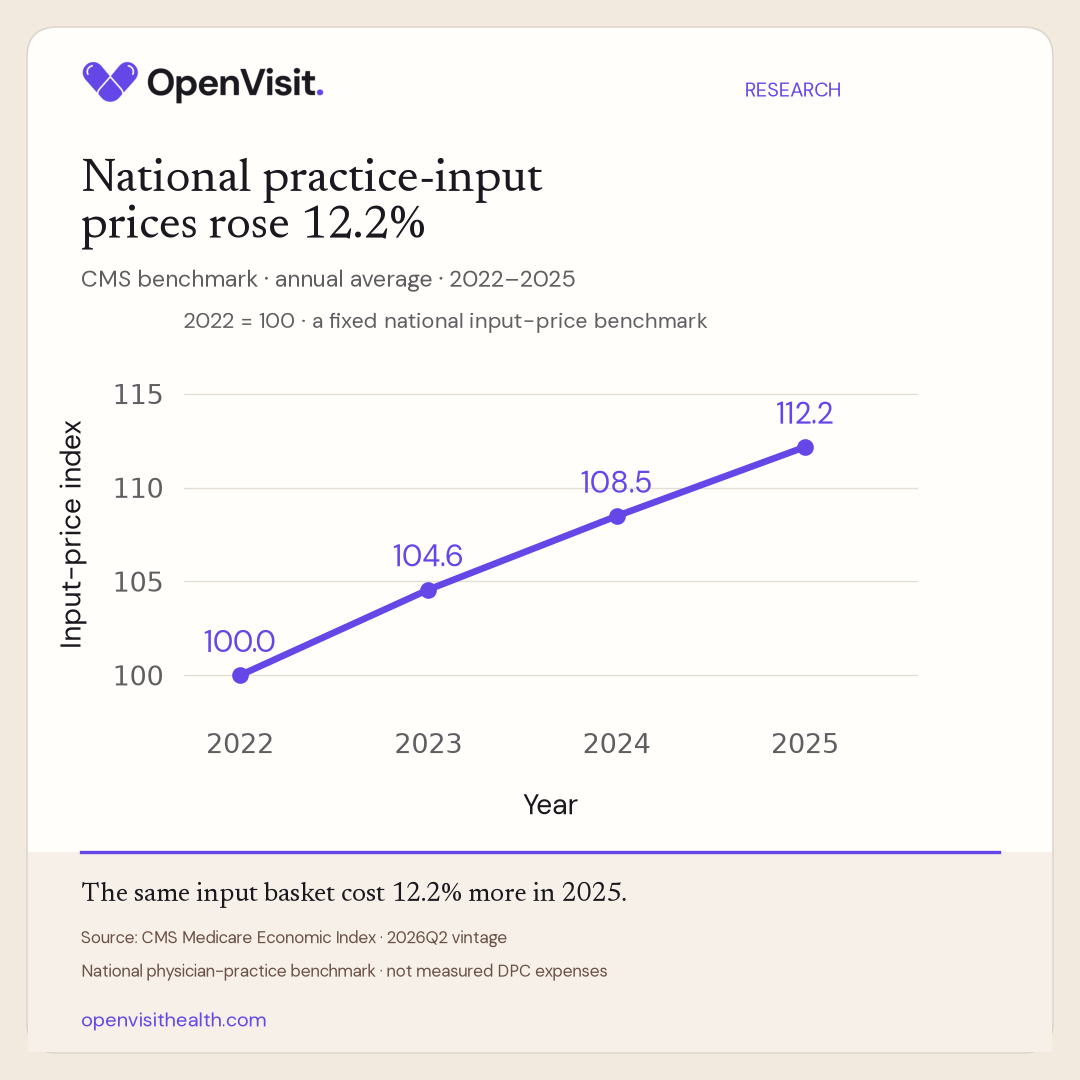
National physician practice input prices rose 12.2% from 2022 to 2025, according to OpenVisit’s analysis of the CMS Medicare Economic Index. For direct primary care practices, it’s a reason to check whether monthly dues still cover the staff time, supplies, and services members use. The index tracks costs across physician practices. Your own records show what it costs to deliver your membership.
What the 12.2% figure tells you
OpenVisit compared annual averages of the underlying CMS Medicare Economic Index from 2022 and 2025. The index tracks prices for inputs used across physician practices, including physician labor and operating expenses. On the chart, 100 represents the 2022 baseline and 112.2 represents the 2025 level. The comparison gives a national benchmark. A DPC office’s costs depend on its own staffing, lease, panel size, and membership terms.
Build a monthly cost per member
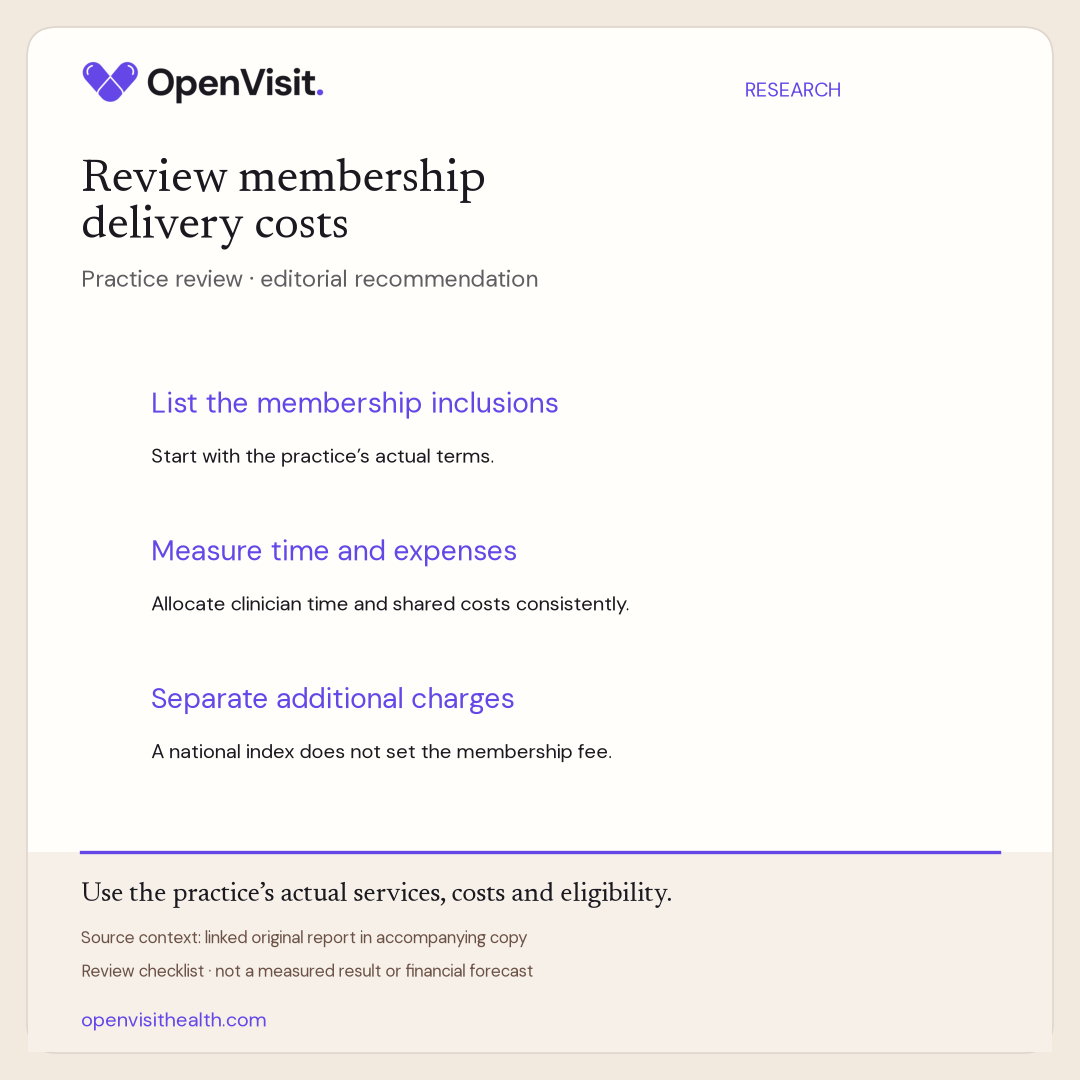
Start with payroll and employer costs, rent, software, supplies, and any tests included in dues. For an owner who takes draws instead of a salary, include a reasonable cost for the clinical work they do. Avoid counting the same clinician or staff time twice if it is already in payroll. If the same office also bills insurance or sells separate services, allocate shared costs using a consistent basis such as staff hours or room use. Compare membership costs with membership dues collected for the same period.
Then look at how the work breaks down. A week of time tracking can help you see whether the pressure comes from visits, inbox work, lab follow-up, or administration. That distinction matters: two practices can have the same monthly cost per member and need very different changes.
What that looks like with 400 members
Suppose a practice has 400 active members, collects $30,000 in monthly dues, and spends $26,000 delivering and supporting membership care. That’s $75 collected and $65 spent per member, leaving $10 per member before any costs excluded from the tally. These are illustrative figures.
Now suppose the practice needs another $3,000 a month in staffing to keep up with messages and follow-ups. At the same panel size, that adds $7.50 per member. The remaining amount drops to $2.50 per member. The staffing decision matters even if visit volume and dues stay flat.
Decide what needs to change
Run the same calculation for three months. If staffing is driving the increase, check whether routine inbox and follow-up tasks can move to the appropriate team member while preserving access. If included tests are driving it, break out which tests account for the increase and check the current membership terms before considering a change. If the panel is growing, track response times and appointment availability alongside cost per member so you can see when added dues come with a need for more staff time.
The next time you review dues, bring three numbers: dues collected per member, cost per member, and the cost of the next staffing change. That gives you a concrete basis for deciding whether to adjust dues, change how work is assigned, or cap panel growth for now.
Use the same denominator each month
If people join or leave midmonth, count partial months consistently. Keep one-time enrollment fees, refunds, and revenue from separately billed care visible as separate lines. For staffing decisions, compare recurring dues against recurring costs, then set aside cash for irregular expenses such as equipment replacement.
What this example does—and does not—measure
The national index is a historical input-price benchmark. It does not establish that DPC dues, demand or margins changed by the same amount. The membership example above is an OpenVisit illustration, not a surveyed practice or a market average. Its remaining balance is not necessarily profit: taxes, debt service, owner compensation or other omitted costs can change the result.
In the illustration, $30,000 divided by 400 members is $75 per member; $26,000 divided by 400 is $65. The added $3,000 staffing expense is $7.50 per member, leaving $2.50 before excluded costs. The arithmetic shows why the next staffing decision deserves its own forecast; it does not prescribe a membership price.
Membership terms and patient obligations need their own review. A national practice-cost index does not establish insurance coverage, replace comprehensive insurance or determine how Medicare-covered services may be billed. Check the actual service agreement and applicable requirements before changing what patients pay or what the practice promises.
Chart definitions: The chart is a national physician-practice input-price index, not measured DPC overhead. Setting 2022 to 100 makes 112.2 in 2025 a 12.2% increase from that baseline. It is not a membership price. Recurring dues, included care and separately billed services are different quantities.