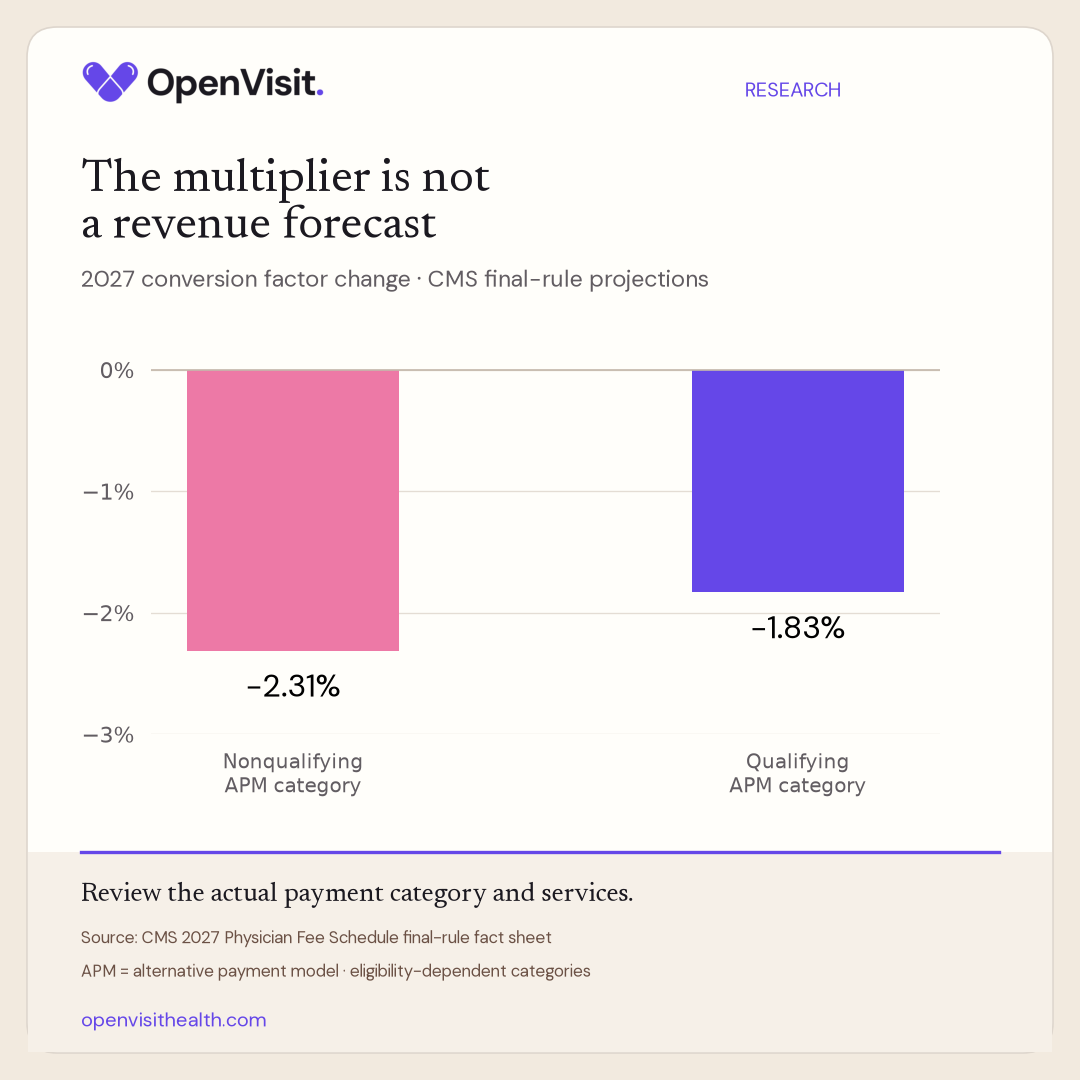
CMS’s November 4 physician-payment fact sheet projects a 2.31% drop in the 2027 conversion factor for clinicians who do not qualify for the alternative-payment-model category, and 1.83% for those who do. A conversion factor is the dollar multiplier in the fee calculation. Your practice should review the actual services and settings it bills before applying either headline to a revenue forecast.
Start with the service, not the headline
Use a small list of frequently billed services and the correct setting. For each, compare the applicable allowed amount, then keep actual collections and volume in separate columns. A national multiplier change does not capture every change to the way a service is valued. It also does not show what the practice will collect after claim-specific adjustments.
Check which category actually applies
Ask the billing team to confirm which payment category applies to the clinicians being modeled. Do not assume that participating in a care organization automatically establishes the relevant qualification. If status is unconfirmed, retain that uncertainty in the worksheet instead of assigning the more favorable amount.
The ongoing-care payment changes are material
The CMS fact sheet finalizes replacing G2211 with the B1 modifier: a 16% increase to an eligible base visit’s payment. A separate B2 modifier provides 32% for specified Shared Savings Program or LEAD ACO practitioners. These are eligibility-dependent policies, not a payment increase for every primary-care appointment. For a practice delivering ongoing care, identify which visits and practitioners qualify before modeling the effect. The conversion-factor decline alone misses this part of the rule.
The final same-day rule differs from the proposal
For a separately identifiable office visit furnished with a zero-day global procedure on the same day, CMS says the most expensive service is paid in full and the other applicable service at 80%. The final policy narrows the proposal, which also covered ten- and ninety-day global procedures and used 50%. A procedure-heavy practice should review its actual combinations rather than build its forecast around the superseded proposal. Check the complete billing requirements with the billing team before applying the rule.
For hybrid and DPC practices
Keep Medicare analysis apart from self-pay prices and membership receipts. A hybrid practice can review both lines of business, but they have different service definitions and obligations. A DPC membership fee is not a Medicare conversion factor. Neither this headline nor our interpretation determines whether a patient can appropriately be charged cash for a covered service.
What to do before January
Prepare the service list, confirm the applicable payment category and setting, review eligibility, and have the billing team validate the assumptions against the final files. Only then build the practice-level forecast. The fact sheet is the source for the payment-policy context; the review sequence here is OpenVisit’s practical interpretation, not individualized billing advice.
Chart definitions: The conversion factor is the dollar multiplier used in the Medicare physician payment calculation. APM means alternative payment model. Qualifying and nonqualifying describe distinct payment categories, not simply whether a practice belongs to a care organization. These are projected 2027 multiplier changes, not total payment or revenue changes.