OpenVisit Research · Primary care · Historical payment analysis
A base visit fee can give an incomplete picture of payment for ongoing care. Our historical Medicare comparison shows why practices should examine eligible add-on payments alongside their actual delivery costs.
For a primary-care practice, the financial question is what the payment supports: clinician time, staff work, follow-up and the operating expenses of delivering care. Looking only at a base visit code can miss part of the allowed payment. Looking only at a national cost index can miss what is happening inside the practice.
OpenVisit’s calculation from the CMS Medicare Economic Index input-price data shows a 12.2% increase in the national benchmark from 2022 to 2025. That is historical context, not a measurement of an individual primary-care office’s expenses.
The comparison changes when an eligible add-on is included
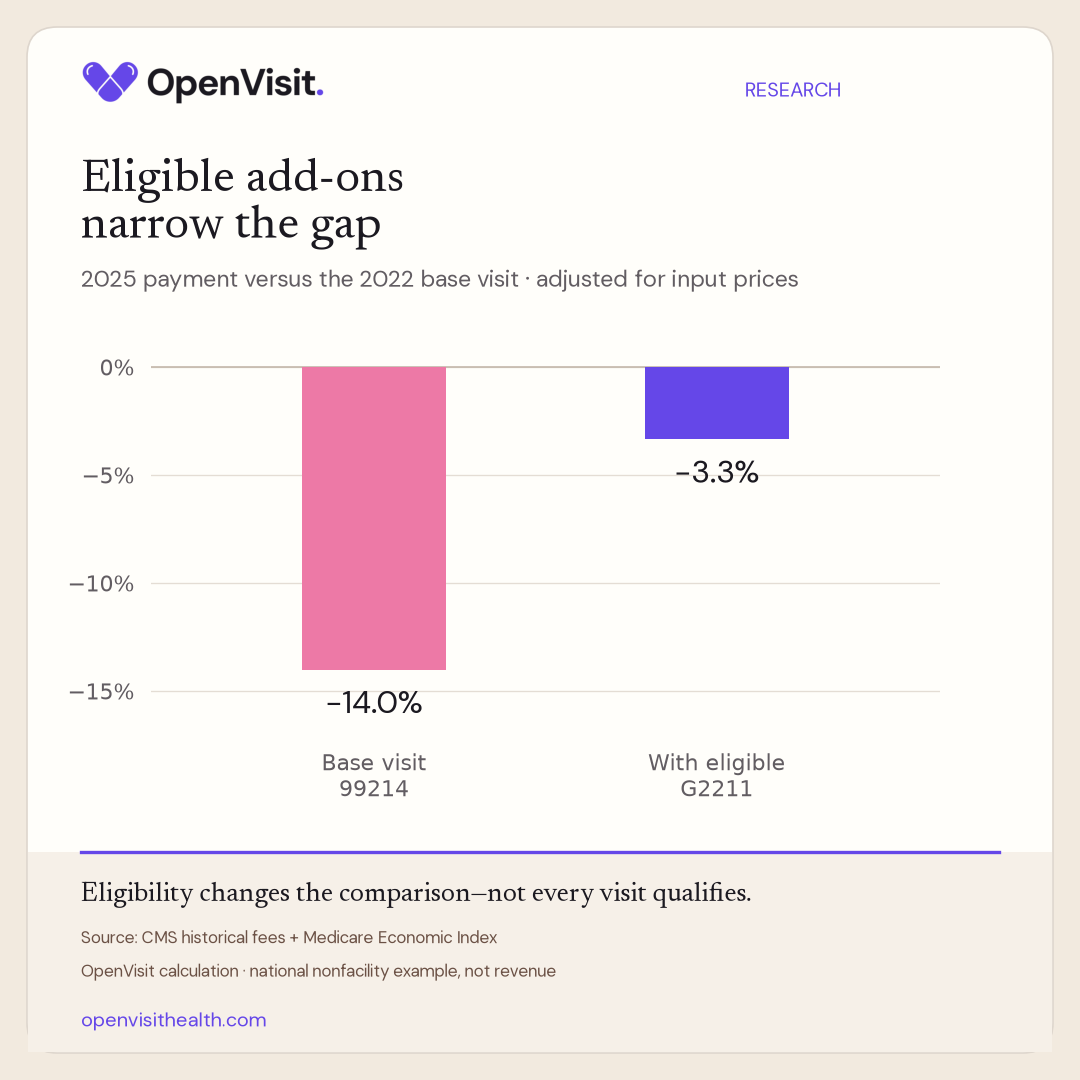
Using the preserved CMS physician fee schedule inputs, our national, geographically unadjusted example compares the 2025 payment for an established office visit, 99214, with the 2022 base visit. After adjustment for the national practice-input price benchmark, the base visit alone is 14.0% below the 2022 reference. Including an eligible G2211 payment narrows that difference to 3.3%.
| Scenario | Allowed amount | Cost-adjusted change from 2022 base |
|---|---|---|
| 2022 base visit | $129.77 | Reference |
| 2025 base visit | $125.18 | −14.0% |
| 2025 base + eligible add-on | $140.71 | −3.3% |
The allowed amounts above are nominal historical amounts. The percentage changes separately account for the input-price benchmark. Both 2025 scenarios are compared with the same 2022 base visit. This is not a comparison of an identical base-plus-add-on combination across both years, and it does not show that every appointment could receive the higher amount.
Eligibility comes before a payment target
The CMS G2211 guidance ties the add-on to the ongoing patient-practitioner relationship, including continuing responsibility for a patient’s care or ongoing care for a serious or complex condition. It is reported with an associated office/outpatient evaluation and management service. A practice’s specialty alone does not establish eligibility.
The guidance also addresses documentation, modifier restrictions and specified preventive-service exceptions. Patient coinsurance and deductible can apply. Those details belong in a claim review; the chart is not an instruction to add a code to every visit.
Because this example concerns 2025 payments, apply the requirements for the actual date of service when reviewing claims. Historical results should not be treated as a current-year billing forecast.
Separate allowed payment from money collected
An allowed amount is not the same as the amount the practice collected. Nor does a cost-adjusted payment change establish a change in total revenue, expenses or profit. A practice-level review needs its actual paid claims and patient collections, as well as its own costs.
Start with a defined group of services over a consistent period. Keep the base service, any eligible add-on, allowed amount and collection outcome distinguishable. A missing payment, a denied claim and an amount still awaiting collection are different operational problems. A national fee comparison cannot identify which one a particular office has.
Use your own costs for the operating decision
The national index gives a common benchmark for this historical calculation. It cannot establish the office’s rent increase, staffing expense or cost of follow-up. Use actual payroll, supplies and other relevant expenses to assess what delivering the selected care requires.
If the practice mixes Medicare, commercial insurance, direct-pay visits or memberships, keep those streams visible. Their payment rules and delivery commitments differ. An improvement in an eligible Medicare payment example does not establish that a membership is sustainably priced or that another payer’s services cover their costs.
A practical review to bring to the team
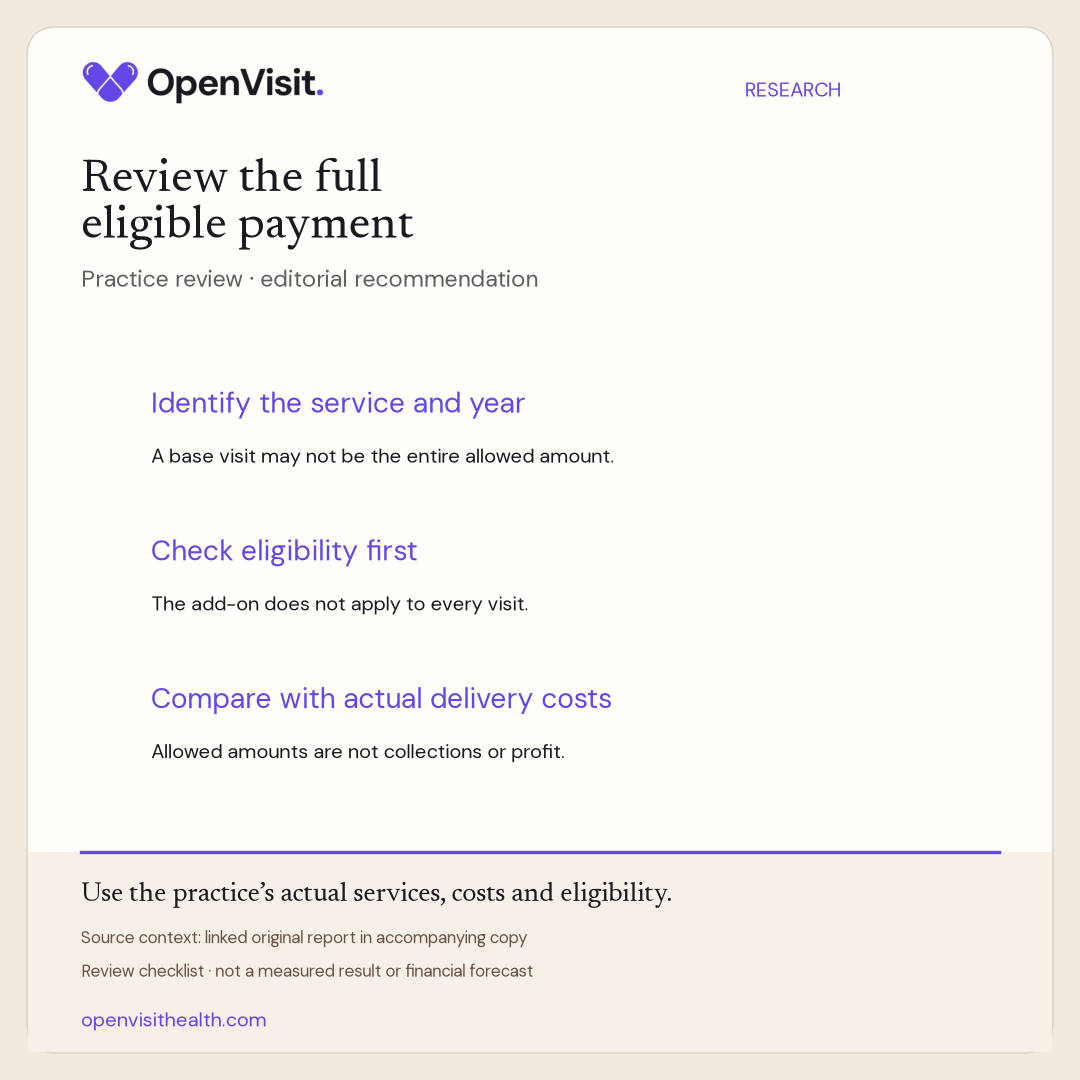
Choose a sample of longitudinal-care claims and have the billing team review eligibility and documentation against the applicable guidance. Check whether qualifying add-ons were reported and how the claims were adjudicated. Then compare the resulting collections with the practice’s own cost information for the same period.
Record what the review actually finds. Correctly paid claims, documentation gaps, eligibility exclusions and collection delays call for different responses. These are proposed review steps, not evidence that a particular practice has underbilled or would recover a given amount.
The useful conclusion from this example is specific: a base-code-only comparison can miss eligible payment. The next decision should come from the practice’s claims and cost records, rather than applying a national percentage to every visit.
Sources and method
Amounts and calculations reuse OpenVisit’s preserved historical CMS source packet and independently reproduced primary-care calculation receipt. The input-price adjustment uses the ratio of annual mean raw Medicare Economic Index levels for 2025 and 2022, before productivity adjustment. Historical national nonfacility fee inputs use the existing calendar-day-weighted schedules. The example describes historical national payments rather than a forecast or a practice-specific payer sample.
Cost-adjusted change equals the payment ratio divided by the input-price ratio, minus one. The calculations reproduce −14.0055% for the base visit and −3.3395% with the eligible add-on, displayed as −14.0% and −3.3%. Figures are rounded for presentation; calculations retain the original precision.
OpenVisit analysis and editorial recommendations are distinct from CMS guidance. This article does not establish an individual practice’s payer mix, billing eligibility, collections or margins.
Chart definitions: Base visit means the allowed payment for 99214 alone. With eligible add-on means that visit plus G2211 only when billing requirements are met. Cost-adjusted compares the payment with national practice-input prices. Both 2025 scenarios use the 2022 base visit as their reference; neither measures practice profit.